As I mentioned in my Abbotsford post, the house provides a free volunteer lead shuttle from Tweedbank Railway Station to Abbotsford, but also from Abbotsford to Melrose Abbey. As it’s volunteer lead this isn’t always available (check Abbotsford’s website for details/contact info) but happily the shuttle was available on the day I visited and the driver offered to take me to the Abbey when I was done at the house (I was the only person using the shuttle that day). The drive didn’t take very long and you’re set down in a car park opposite the Abbey. The shuttle doesn’t take you back to the station but the driver pointed to a bus stop nearby and said that was where I could get the bus back to Tweedbank (it wasn’t – but more on that later!)
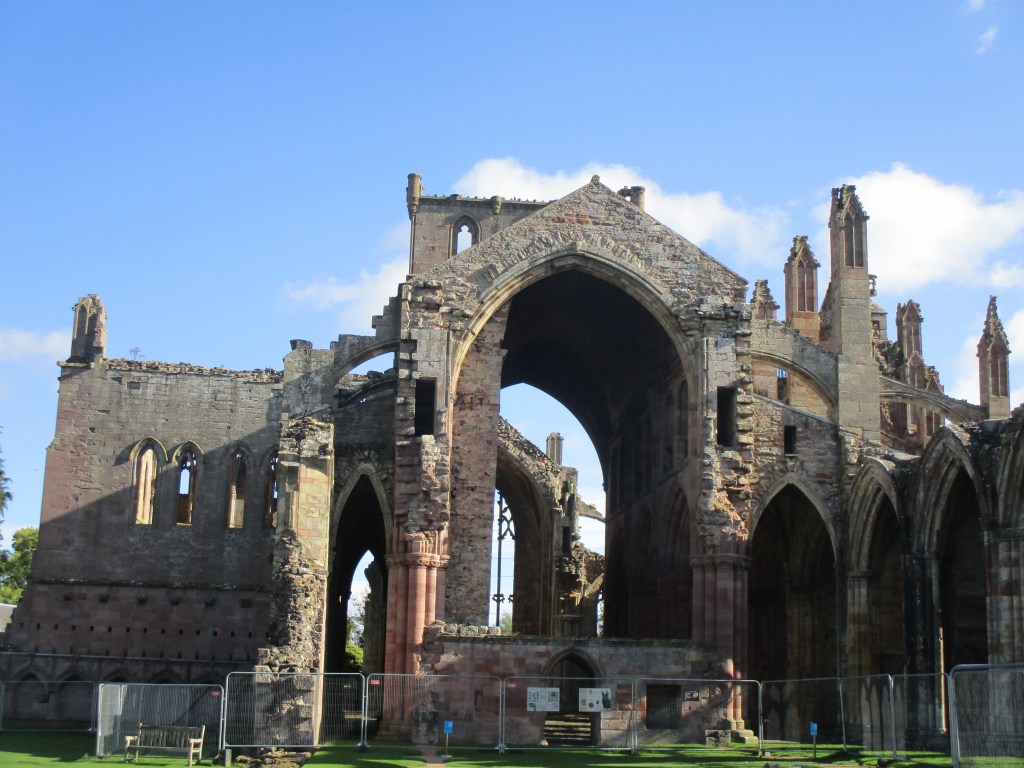
The site is run by Historic Scotland and as a member of one of their partner organisations (English Heritage) I had free entry, otherwise an adult ticket costs £7.50. Do note that because of work to preserve the abbey parts of it are still covered in scaffolding – pay attention to relevant signs and check their website for any closures. The website suggests booking in advance – mid-October there was only me and two other tourists so I can’t say how busy it gets in the summer.

I didn’t know anything about the abbey before I arrived other than it had some connection to Robert the Bruce. Helpfully there are some information boards dotted around but I would recommended buying a guidebook, or alternatively there is an audio guide you can download on your phone. In its heyday the abbey was in fact one of Scotland’s most powerful and richest medieval abbeys. It was founded by David I in 1136 and was the first Cistercian monastery in Scotland.

Now largely ruins it is still an imposing Gothic structure. The original 12th century church was destroyed by the English army in 1385, this church dates from 1400. The main building has many carvings along its walls and you are particularly directed to keep an eye out for the pig playing the bagpipes!

The abbey is thought to be the burial place of Robert the Bruce’s heart, which is marked with a commemorative plaque. It was apparently Robert’s dying wish that his heart be carried on a crusade to the Holy Land and then be buried at Melrose. His body was buried at Dunarline Abbey.

After walking around the site and through the graveyard I then crossed back to near the entrance but headed through a gate and across the road to the small museum that is also included in the entrance fee (not that anyone was around to check mind you, I had the whole place to myself).

The contents of the museum was mostly bits of archaeological finds from the area.

Upstairs however there was this wonderful display of dolls representing important figures from the history of the abbey. Some of my favourites were those of John Morrow, the architect said to be responsible for part of the abbey’s design,

…Sir William Keith who is here holding a small casket containing Robert the Bruce’s heart ready to be buried at the abbey…

…and Anne, Duchess of Buccleuch who bought the lordship of the abbey and whose descendents would gift it to the nation in 1919.

It’s a beautiful place to visit and worked well with a visit to Abbotsford.
Now, about getting back to Tweedbank Station from the Abbey if you’re using public transport. Leave the Abbey site and make your way to the car park opposite the entrance. Continue down that street to the right, with the Abbey directly behind you. There’s an alleyway to the left, walk all the way through that and you’ll come out on a main street. Cross the road and the bus stop there is the one you need. The buses are pretty regular and you can use contactless to buy your ticket.
 Louise Jayne's Blog