Cambridge is full of small museums tucked away in university departments. I managed to tick off quite a few on my last visit to Cambridge but there were still some I wanted to visit which included the Museum of Classical Archaeology. Hidden away in the Faculty of Classics and up a short staircase (there is a lift available) the museum is free and contains over 450 plaster casts of Greek and Roman sculpture.
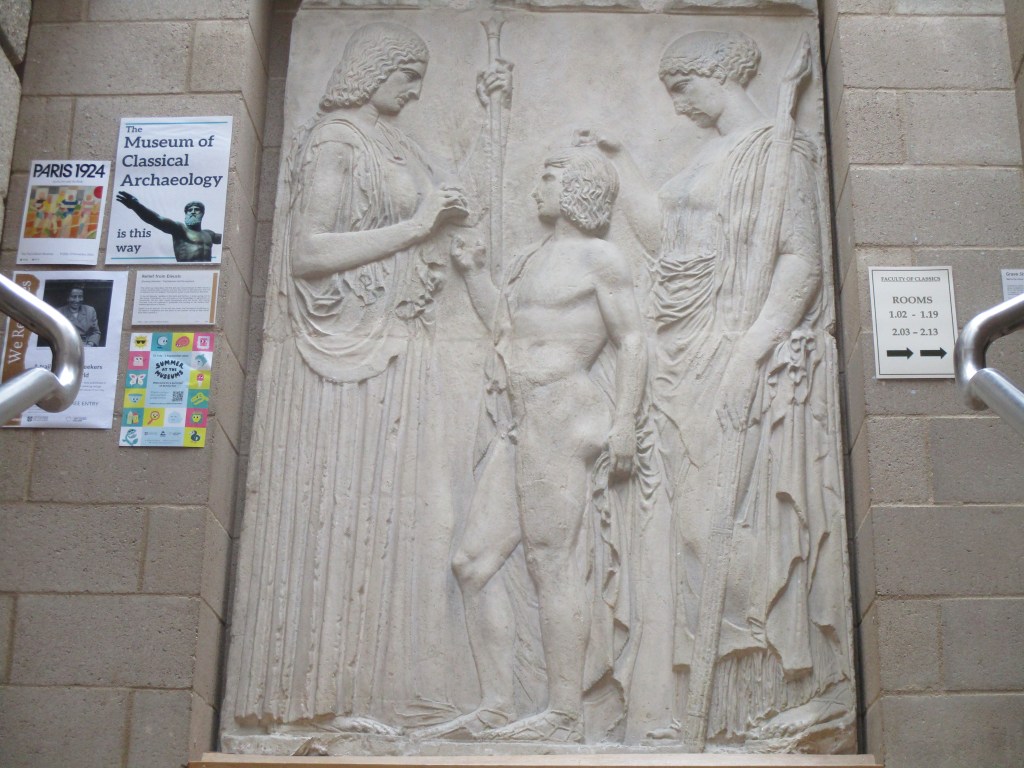
I wasn’t sure what to expect but I really enjoyed wandering around here. There are several different trails to follow if you wish including one that explores how colourful ancient sculptures would have been and one focusing on LGBTQ+ representation in ancient sculptures. I took a somewhat piecemeal approach dipping into aspects of each trail.

The range of plaster casts dates from 1700 BCE to 400 CE, from small fragments to absolutely huge statues. One of the largest statues (and my photo really doesn’t capture the size) was this statue called Amelung’s Athena. In the early 20th century Walther Amelung created this statue of the goddess Athena taking elements of the design from descriptions of the 12 metres tall statue of Athena that once stood inside the Parthenon in Athens and which would have been coated in gold. (There’ll be more about this when I start posting about my trip to Athens). I also particularly enjoyed the accompanying owl, the symbol of Athena’s wisdom.


One of the most well known plaster casts is that of the Peplos Kore which is painted in bright colours (a kore is a statue of a young woman, typically used to mark graves, with a stiff posture looking straight forward). The idea for the colourisation of the statue was the work of Professor Robert M. Cook, the curator of the museum back in 1975; he wanted people to consider how brightly coloured the ancient world had actually been, since we are so used to seeing white statues with their colours faded we tend to think of the ancient world as being very white and plain.

The museum was founded in 1884 – in 1879 Art and Archaeology had become part of the Classics degree offered at the university and lecturers used plaster casts such as these as visual aids. Many of the earliest casts were donated from the Fitzwilliam Museum which in turn had received them from wealthy donors. The museum moved to its present site in a purpose built gallery in 1983 – not on display are literally thousands of plaster casts in the museum’s archives.

I enjoyed photographing, admiring, and reading about the statues so much that it was difficult to choose any particular favourites but here are some that attracted my attention. This first is a plaster cast from the Temple of Artemis in Corfu of the Gorgon Medusa, terrifyingly impressive in all her glory.

This impressive figure is The Cape Artemision God, a rare example of a surviving full size Greek bronze – the original is in the National Museum in Athens. It dates from around 460 BCE and survived because it sank in a shipwreck and so didn’t end up being reused as scrap metal, which was the fate of so many of its predecessors.

This beautiful piece – I love the way the dress seems to move – is a relief of a dancing Maenad and interestingly is actually thought to be a forgery. Most sculptures of dancing Maenads (the female followers of Dionysus) it turns out are Roman copies based on original Greek designs but this one has its head and arms in the opposite way they would have actually been depicted, and the folds of the garment are regular, whereas normally they would be more asymmetrical.

And finally there is this striking scene which depicts Laocoon and his sons being killed by serpents sent by the gods. Laocoon was the Trojan priest who warned against Greeks bearing gifts, and was ignored with as we know disastrous results. The gods had him killed because they were supporting the Greeks. The original of the statue is in the Vatican.

I really enjoyed my time here; the term hidden gem gets thrown around a lot but I certainly think this museum qualifies. An excellent place to while away some hours.
 Louise Jayne's Blog
I loved getting a look at these statues, Louise. Thanks.
LikeLiked by 1 person